


Page 49 - The Market For Ideas no. 1, 2016
P. 49
ECONomen


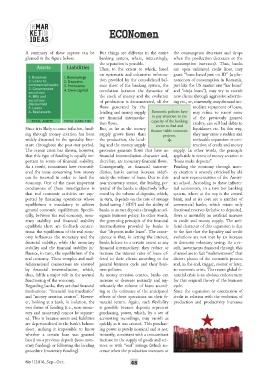
            A  summary  of  these  aspects  can  be  But  things  are  different  in  the  entire  the  consumption  decreases  and  drops
            gleaned in the figure below:     banking  system,  where,  interestingly,  when the production decreases or the
                                             the separation is possible.      consumption  increases).  Thus,  banks
                                             Thus,  to  the  extent  to  which,  based  can  open  unlimited  credit  lines,  may
                                             on systematic and exhaustive informa-  grant “loans based just on ID” (a phe-
                                             tion provided by the consolidated bal-  nomenon of consumption in Romania,
                                             ance sheet of the banking system, the  just like the US market saw “liar loans”
                                             correlation  between  the  dynamics  of  and  “ninja  loans”),  may  try  to  recruit
                                             the stock of money and the evolution  new clients through aggressive advertis-
                                             of production is demonstrated, all the  ing etc., or, conversely, may demand im-
                                             flows  generated  by  the                 mediate repayment of loans,
                                             lending and money supply                  may  refuse  to  renew  some
                                             are  financial  intermedia-               of  the  previously  granted
                                             tion flows.                               credits, can sell bad debts to
            Since it is likely to cause inflation, fund-  But,  as  far  as  the  money   liquidators etc. In this way,
            ing through money creation has been  supply  grows  faster  than           they may cause a sudden and
            widely discussed in the specialty liter-  the production, the lend-        noticeable expansion or con-
            ature throughout the post-war period.  ing and the money supply            traction of credit and money
            The recent crisis has shown, however,  processes  generate  flows  that  have  no  supply.  In  other  words,  the  principle
            that this type of funding is equally im-  financial intermediation character and,  applicable in terms of money creation is
            portant  in  terms  of  financial  stability.  therefore, are monetary financial flows.  “loans make deposits”.
            As a result, economists have reconsid-  Consequently,  as  financial  interme-  Funding  the  economy  through  mon-
            ered the issue concerning how money  diaries,  banks  cannot  increase  indefi-  ey creation is severely criticized by old
            can  be  inserted  in  order  to  fund  the  nitely the volume of loans. Due to this  and new representatives of the Austri-
            economy.  One  of  the  most  important  non-monetary stance, the lending po-  an school. According to these influen-
            conclusions  of  these  investigations  is  tential of the banks is objectively influ-  tial economists, in a two tier banking
            that  real  economic  activities  are  sup-  enced by the volume of deposits, which,  system, where at the top is the central
            ported  by  financing  operations  whose  in turn, depends on the rate of savings  bank, and at its core are a number of
            equilibrium  is  mandatory  to  achieve  (total saving / GDP) and the ability of  commercial  banks,  which  retain  only
            general economic equilibrium. Specifi-  banks to attract deposits through an ad-  fractional reserves (relative to deposits),
            cally, between the real economy, mon-  equate business policy. In other words,  there is inevitably an artificial increase
            etary  stability  and  financial  stability  the governing principle of the financial  in credit and money supply. The arti-
            equilibria  there  are  feedback  connec-  intermediation  provided  by  banks  is  ficial character of this expansion is due
            tions: the equilibrium of the real econ-  that “deposits make loans”. The conse-  to the fact that the liquidity and credit
            omy  influences  the  monetary  and  the  quence is that, in setting the interest,  evolutions  are  not  met  by  an  increase
            financial  stability,  while  the  monetary  banks behave to a certain extent as any  in domestic voluntary saving. As a re-
            stability  and  the  financial  stability  in-  financial  intermediary:  they  reduce  or  sult, investments financed through this
            fluence, in turn, the equilibrium of the  increase the interest rates of loans of-  channel are in fact “malinvestment” that
            real economy. These complex and mul-  fered to their clients according to the  distort phases of the economic process
            tidimensional connections are ensured  general  business  cycle  and  their  busi-  and, in the end, trigger, sooner or later,
            by  financial  intermediation,  which,  ness policies.            an economic crisis. The recent global fi-
            thus, fulfils a major role in the normal  As money creation centres, banks can  nancial crisis is an obvious endorsement
            functioning of the economy.      increase or decrease instantly and sig-  for this original theory of the business
            Regarding banks, they are dual financial  nificantly the volume of loans accord-  cycle.
            institutions:  “financial  intermediaries”  ing to the estimates of the anticipated  Since  the  expansion  or  contraction  of
            and “money creation centres”. Howev-  effects of these operations on their fi-  credit in relation with the evolution of
            er, looking at a bank, in isolation, the  nancial  return.  Again,  such  flexibility  production  and  productivity  increases
            two forms of funding (i.e., non-mone-  is  possible  because  deposits  represent
            tary and monetary) cannot be separat-  purchasing  power,  which,  by  a  set  of
            ed. This is because assets and liabilities  accounting  recordings,  may  vanish  as
            are depersonalized in the bank’s balance  quickly as it was created. This purchas-
            sheet,  making  it  impossible  to  know  ing power is purely nominal and is not,
            whether  a  certain  loan  was  granted  instantly, consistent with a concomitant
            based on a previous deposit (non-mon-  increase in the supply of goods and ser-
            etary funding) or following the lending  vices or with “real” savings (which in-
            procedure (monetary funding).    crease when the production increases or


            No 1/2016, Sep.-Oct.                           48

