


Page 48 - The Market For Ideas no. 1, 2016
P. 48
In Romania, the volume of loans grant-  worth”.                   is  designated  as  “indirect  funding”  of
            ed  to  non-bank  customers  at  the  end  The “Deposits” position requires a spe-  economic activity.
            of January 2016 was 216,112.2 million  cial  attention.  The  word  “deposit”  is  But,  when  loans  are  covered  by  the
            lei, equivalent to approx. 40% of GDP  used here in a broad sense, covering a  deposit created once the loan is trans-
            (according to NBR data).         wide range of banking liabilities, from  ferred in the client’s account, the bank
            Banks finance their loans through four  demand  deposits  and  savings  to  bank  credit  is  a  “monetary  financing”.  The
            types of resources: a) long-term avail-  liabilities documented by certificates of  bank records the new loan as an asset in
            able  resources  they  obtain  through  deposit, bonds issued by the bank etc.  its balance sheet because the operation
            long-term  loans  borrowed  from  oth-  The distinctive feature of all these bank  gives rise to a receivable on its client /
            er  banks  and  financial  institutions;  b)  liabilities other than net worth is that  debtor;  equally,  it  recorded  the  same
            equity (own capital and reserve funds);  though  to  the  bank  they        value as a liability (deposit)
            c) deposits available for a limited time  count  as  “debts”,  to  the      on behalf of the same cli-
            span  that  banks  receive  from  various  non-banking sector (Main         ent. These simple account-
            customers  similar  to  non-banking  fi-  Street  in  American  par-        ing records, however, have
            nancial  institutions;  d)  money  created  lance,  as  opposed  to  Wall   major  economic  conse-
            by the banks that, as we shall later de-  Street)  they  are  more  or      quences  because  bank  de-
            scribe, is both fuelled by deposits and  less  liquid  “receivables”,       posits are (account) money,
            then fuels deposits.             and therefore perform the                  acknowledged  as  such,  in
            The destination of monetary resources  functions of money: a medium of ex-  all modern economies. But it is obvious
            is represented by loans and other finan-  change, unit of account, store of value  that these operations do not involve a
            cial  placements  granted  by  banks:  a)  etc.  Therefore,  these  receivables  are  “financial  intermediation”  and,  conse-
            loans to the public treasury through the  considered and function as money, in-  quently, the financing of the economy
            purchase of state bonds; b) short-term,  cluding  all  monetary  aggregates  (M1,  is a “direct financing”.
            medium and long term loans to busi-  M2 etc.). On the other hand, these de-  Secondly, the deposit does not “disap-
            nesses and households; c) investments  posits  represent  financial  investments  pear” as liability from the balance sheet
            made  in  financial  markets  by  buying  for  their  holders,  because  even  if  the  when the borrowed amount is used by
            long-term  securities:  shares,  bonds,  initial deposit was created as a demand  the client to purchase a good, a service
            other financial assets; d) specific lend-  deposit,  the  final  holder  of  a  savings  or a financial asset. If the seller of the
            ing operations: leasing, mortgages etc.  account  usually  requests  an  interest,  good, service or financial asset is anoth-
            In Romania, at the current date, almost  its level depending on its liquidity and  er bank’s client, the deposit leaves the
            half of bank loans were denominated in  yield.                    original debtor’s account and fuels the
            foreign currency.                In this context, there may be some con-  seller’s  bank  balance  sheet,  but  does
            Given  the  previously  stated  facts,  the  fusion, and to remove it requires some  not leave the banking system until the
            balance  sheet  of  commercial  banks  clarification.             original loan is reimbursed. Banks are,
            shows (in principle) as follows:  Deposits can be made not only by regu-  therefore, elements of an interconnect-
                                             lar inflows (wages and salaries, business  ed financial system, not isolated entities.
                                             and commercial incomes etc.), but also  Finally,  there  is  no  reason  to  assume
                                             when the bank grants a loan.     that  this  loan  will  be  repaid  immedi-
                                             As long as it is funded by a previously  ately. On the contrary, a loan is granted
                                             opened  deposit,  the  loan  stands  for  a  precisely because it will serve to finance
                                             “non-monetary  funding”:  consequent-  certain “real” economic activities (pro-
                                             ly, “banks lend other people’s money”  duction,  trade,  consumption,  invest-
                                             – as it is often said. In this case banks  ment  etc.)  that  generate,  in  turn,  an
                                             play a financial intermediation role be-  increased  demand  for  money.  If  loans
                                             tween individuals who save (i.e., spend  are widely used to finance relatively un-
                                             less than they earn) and those who need  productive economic activities, there is
                                             those resources (i.e., spend more than  a  generalized  increase  in  the  prices  of
                                             they earn). In other words, the bank, as  goods,  rendered  services  and  financial
                                             the NFIs also do, is connecting those  assets (i.e., inflation occurs).
                                             who have disposable capital, but do not
                                             use it and those who would use it, but
                                             do not have it. The socially important
                                             process  that  arises  from  the  redistri-
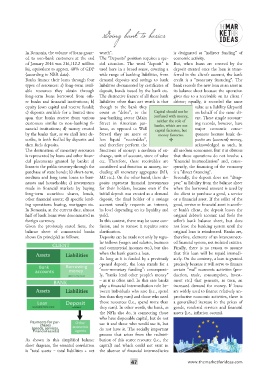
            As  shown  in  this  simplified  balance  bution of this scarce resource (i.e., the
            sheet diagram, the essential correlation  capital)  and  which  could  not  exist  in
            is  “total  assets  =  total  liabilities  +  net  the  absence  of  financial  intermediaries


                                                           47                       www.themarketforideas.com

