


Page 24 - The Market For Ideas no. 1, 2016
P. 24
The     Uneasines  s of Toget  he  rnes  s

                                                                have built their political identity on hostility towards
                                                                communism  and  the  Polish  successor  party,  the
                                                                Democratic Left Alliance. Nevertheless, PiS has not
                                                                shied away from capitalising on the leftist niche, by
                                                                promoting a resonant policy agenda (see Table 1).
                                                                According  to  some  researchers  (Smolnar  in
                                                                Pankowski and Kormak 2013, 162), the vision of the
                                                                PiS  leadership  is  “hierarchical,  [revolving  around]
                                                                the nation, community, patriotism, traditionally-
                                                                interpreted  values,  state  paternalism,  and  social
                                                                solidarity”. The ideology of the party is characterized
                                                                as  “national-conservative  populism”,  although  in
                                                                2007 and 2011 a number of activists known for their
                                                                far  right  views  were  absorbed  and  moderated  by
                                                                the party, and the party continued to collaborate
                                                                and form a strategic alliance with Radio Maryja,
                                                                a  religious  Polish  radio  station  (Pankowski  and
                                                                Kormak 2013, 162).
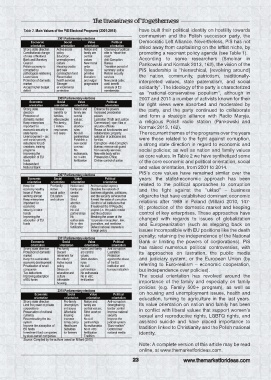
                                                                The recurrent themes of the programs over the years
                                                                were  those  related  to  the  fi ght  against  corruption,
                                                                a strong state direction in regard to economic and
                                                                social policies; as well as nation and family values
                                                                as core values. In Table 2 we have synthetized some
                                                                of the core economic and political orientation, social
                                                                and value orientation, from 2001 to 2014.
                                                                PiS’s  core  values  have  remained  similar  over  the
                                                                years:  the  statist-economic  approach  has  been
                                                                related to the  political approaches to corruption
                                                                and  the  fi ght  against  the  “układ”  –  business
                                                                oligarchs that have established dominant economic
                                                                relations  after  1989  in  Poland  (Millard  2010,  147-
                                                                8); protection of the domestic market and keeping
                                                                control of key enterprises. These approaches have
                                                                changed  with  regards  to  issues  of  globalization
                                                                and  Europeanization  (such  as  stepping  back  on
                                                                issues incompatible with EU positions like the death
                                                                penalty; retaining the independence of the National
                                                                Bank  or  limiting  the  powers  of  corporations).  PiS
                                                                has  raised  numerous  political  controversies,  with
                                                                its  approaches  on  lustration,  the  public media
                                                                and  judiciary  system;  or  the  European  Union  (by
                                                                referring to Euro-realism – economic cooperation,
                                                                but independence over policies).
                                                                The  social  orientation  has  revolved  around  the
                                                                importance  of the  family and especially on family
                                                                policies  (e.g.  Family  500+  program),  as  well  as
                                                                on housing and unemployment issues, health and
                                                                education, turning to agriculture in the  last years.
                                                                Its value orientation on nation and family has been
                                                                in confl ict with liberal values that support women’s
                                                                sexual and reproductive rights, LGBTQ rights, and
                                                                assisted  suicide  and  have  placed  importance  to
                                                                tradition linked to Christianity and the Polish national
                                                                identity.

                                                                Note: A complete version of this article may be read
                                                                online, at www.themarketforideas.com.
                                                              23                     www.themarketforideas.com

