


Page 23 - The Market For Ideas no. 1, 2016
P. 23
Commu  ni  ty Schi  sm
                              MAINSTREAMING NATIONALISM?

                                 THE CASE OF THE LAW AND
                                       JUSTICE PARTY (PIS)
                                             An  drada NIMU
                                            Clara VOLINTIRU


          Poland  is  one  of  the  key  actors  in  the  European
          Union  project,  as  well as the  broader regional
          architecture of power. Like its fellow Visegrad group
          of  countries  (Poland,  Hungary,  Czech  Republic,
          and  Slovakia),  the  Polish  party  system  has  been
          signifi cantly  marked  by  the  rising  prominence  of
          nationalist  or  conservative  platforms.  The  major
          political actor employing the nationalist platform to
          rise to power is the the Law and Justice Party (PiS).
          Its  infl uence  surpasses  that  of  its  competitors,  as
          it became a benchmark for other parties following
          the  same  recipe  for  survival  (e.g.  Czech  Social
          Democratic  Party  (CSSD)  led  by  Miloš  Zeman  –
          Czech  Republic,  or  Direction  -  Social  Democracy
          (SMER-SD)  led  by  Robert  Fico  –  Slovakia).  Still,
          the most striking similarity both in terms of party
          platform and in terms of the leadership fi gure is with
          Hungarian  FIDESZ.  In  support  of  this,  we  fi nd  an
          increase in joint statements and common stances
          on the part of Jarosław Kaczyński (PiS) and Viktor
          Orbán (FIDESZ).
          The prospect of a consolidated nationalist platform
          in  Central  and  Eastern  Europe  (CEE)  was  not
          perceived  as  likely  throughout  the  past  decade,
          since the main competitor of PiS, the Civic Platform
          (PO), had proven to be highly successful in domestic
          elections. It also developed a strong presence at the
          EU  level,  with  former  Prime  Minister  Donald  Tusk   the extreme. With regards to European Integration,
          becoming the President of the European Council in     the  DALP  expert  survey  data  suggests  that  PiS
          2014. The puzzle is to address how nationalist and    public discourse  conforms  to  a  policy stance  that
          Eurosceptic parties like the Law and Justice Party    is more critical of the integration process than in
          (PiS)  have  managed  to  rise  to  prominence,  being   favour of further integration. Still, both LPR and SRP
          powerful competitors  in  their  domestic  political   are more Eurosceptic than PiS. With regards to the
          scene.                                                Church, we fi nd the party system heavily polarised,
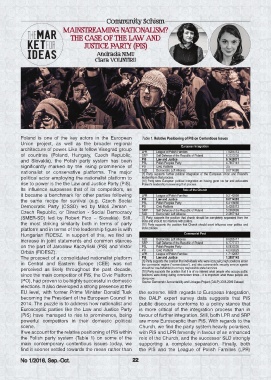
          If we account for the relative positioning of PiS within   with PiS and LPR fervently in favour of an enhanced
          the  Polish  party  system  (Table  1)  on  some  of  the   role of the Church, and the successor SLD strongly
          main  contemporary  contentious  issues today,  we    supporting  a  complete  separation.  Finally,  both
          fi nd it sooner settled towards the mean rather than   the  PiS  and  the  League  of  Polish  Families  (LPR)


          No 1/2016, Sep.-Oct.                               22

