


Page 87 - The Market For Ideas no. 1, 2016
P. 87
KNOWlegacy


            creation, that is to social environment  outstanding work.               Philosophy of science
            and,  generally,  to  the  moral  universe  The book approaches, according to the
            which surrounds it”.             manuscript, civilization only, and com-  Simion  Mehedinți’s  work  involved
            For  many  years,  SM  taught  Ethnog-  prises two parts. The first part covers  Philosophy, as well, which he studied
            raphy  courses  at  the  University  of  issues like “Omenirea ca formație bio-  assiduously during his time in Bucha-
            Bucharest,  Faculty  of  Letters,  which  geografică deosebită de restul animal-  rest (with the help of books from the
            housed  the  department  of  Geography  ității”  (“Humanity  as  a  biogeographic  library of Școala Normală Superioară),
            at  the  time,  publishing  different  edi-  formation distinct from the rest of the  which  he  continued  and  completed
            tions  (starting  with  1921),  revisiting  animal regnum”), “Adaptarea somatică  during his research in France and Ger-
            issues  of  Ethnography  in  his  high  activă:  tehnica  (munca)”  (“Active  so-  many.  He  researched  and  scrutinized
            school  manual  “Antropogeografia”  matic adaptation: techniques (work)”)  the  work  of  great  philosophers  such
            (“Anthropogeography”).  He  collected  and  “Adaptarea  psihică”  (“Psycholog-  as Auguste Comte, Hippolyte Adolphe
            material  for  a  large  book  called  Eth-  ical  adaptation”),  whereas  the  second  Taine, Arthur Schopenhauer, Friedrich
            nos, which would have compared with  part,  larger  in  extent,  covers  different  Nietzsche and Herbert Spencer.
            “Terra.  Introducere  în  geografie  ca  occupations  (hunting,  domestication,  Simion Mehedinți did not publish pa-
            știință”.  Although  Simion                                        pers of philosophy, but he formulated
            Mehedinți  had  mentioned                                          a philosophy of science regarding Geog-
            it  numerous  times,  it  was                                      raphy and Ethnography in a general-
            believed the manuscript was                                        ized  way,  seeking  to  clarify  the  role
            either  lost  or  the  project                                     of  natural  sciences  and  sciences  re-
            was  abandoned.  Yet,  some                                        garding humans through philosoph-
            recent  new  evidence  sug-                                        ical  interpretations.  It  can  be  stated
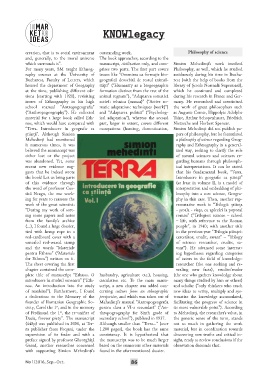
            gests that he indeed wrote                                         that  his  fundamental  book,  “Terra.
            the book! Let us bring parts                                       Introducere  în  geografie  ca  știință”
            of  this  evidence  through                                        (at least in volume I), is a model of
            the word of professor Cos-                                         interpretation and embedding of phi-
            tică  Neagu,  the  one  work-                                      losophy into a core science, Geogra-
            ing for years to reassess the                                      phy in this case. Then, another rep-
            work of the great scientist:                                       resentative  work  is  “Trilogii:  știința
            “During  my  work  of  sort-                                       - școala - viața, cu aplecări la poporul
            ing some papers and notes                                          roman” (“Trilogies: science – school
            from  the  family’s  archive                                       – life, with reference to the Roman
            (…), I found a large dossier,                                      people”,  in  1940;  with  another  title
            tied  with  hemp  rope  in  a                                      in the previous year “Trilogia științei:
            red-cardboard cover with a                                         cercetător, erudit, savant” – “Trilogy
            unsealed  red-waxed  stamp                                         of  science:  researcher,  erudite,  sa-
            and  the  words  “Materiale                                        vant”).  He  advanced  some  interest-
            pentru Ethnos” (“Materials                                         ing  hypotheses  regarding  categories
            for Ethnos”) written on it.                                        of  tutors  in  the  field  of  knowledge:
            The sheet covering the first                                       researcher  (the  one  seeking  and  re-
            chapter contained the com-                                         vealing  new  facts),  erudite/reader
            plete  title  of  manuscript  “Ethnos.  O  husbandry,  agriculture  etc.),  housing,  (the one who gathers knowledge about
            introducere în studiul omenirii” (“Eth-  circulation  etc.  To  the  main  manu-  many things studied by him or others)
            nos.  An  introduction  into  the  study  script, a new chapter was added con-  and scholar (“only thinkers who reach
            of  mankind”).  Furthermore,  I  found  cerning  culture  from  an  ethnographic  new ideas to verity, multiply and sys-
            a  dedication:  to  the  Memory  of  the  perspective, and which was taken out of  tematize  the  knowledge  accumulated,
            founder of Romanian Geographic So-  Mehedinți’s manual “Antropogeografia  facilitating  the  progress  of  science  in
            ciety, Carol the 1 , and in the memory  pentru  clasa  a  VI-a  secundară”  (“An-  its most vulnerable point”). According
                          st
            of Ferdinand the 1 , the re-unifier of  thropogeography  for  Sixth  grade  of  to Mehedinți, the researcher’s value, in
                            st
            Dacia, forever piety”. The manuscript  secondary school”), publised in 1937.  the generic sense of the term, stands
            (448p) was published in 2008, at Ter-  Although smaller than “Terra…” (over  not  so  much  in  gathering  the  work
            ra  publisher  from  Focșani,  under  the  1.200  pages),  the  book  has  the  same  material,  but  in  coordination  towards
            supervision  of  its  finder  and  with  a  consistency.  It  is  hypothesized  that  discovering new truths and critical in-
            preface signed by professor Gheorghiță  the manuscript was to be much larger  sight, ready to review conclusions if the
            Geană,  another  researcher  concerned  based on the numerous other materials  observation demands that.
            with  supporting  Simion  Mehedinți’s  found in the aforementioned dossier.


            No 1/2016, Sep.-Oct.                           86

