The Unsinkable Lusitania Et in Coimbra Ego

The Lusitania sank in less than twenty minutes. The Lusitania that truly mattered never did.
Most people remember Lusitania as the British ocean liner torpedoed by a German U-boat in 1915, a tragedy that helped reshape the course of the First World War. Long before it was the name of a ship, however, Lusitania was the name of a land – a civilization whose greatest voyages began not on the ocean, but in the mind.
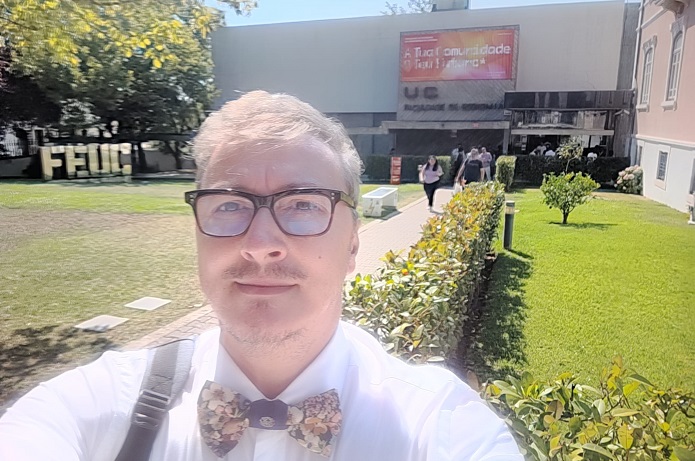
Some nations conquered the world. Others came to understand it. Portugal managed, with remarkable fortune and no little wisdom, to do both – though not quite in that order. Books preceded maps; universities preceded caravels; ideas sailed before ships did. Between July 1 and 3, while attending the Association for Heterodox Economics (AHE) conference at the University of Coimbra, I came away with what may be Portugal’s most enduring secret: the country’s prestige was never built primarily upon its ships, but upon what made those ships possible – education, refined and legitimized over centuries.
The great voyages of discovery were intellectual discoveries before they became geographical ones. Coimbra still speaks that language. Founded in 1290, its university ranks among Europe’s oldest, its centuries-old rivalry with Salamanca mirroring, on an academic scale, the competition between the Kingdom of Portugal and the Crown of Castile. Arguments collided in lecture halls while empires competed across oceans. Later, the Treaty of Tordesillas drew its famous line across the Atlantic, assigning an eastern hemisphere to Portugal and a western one to Spain. Yet long before diplomats and soldiers divided continents, professors and students were already exchanging ideas whose geography would prove more enduring than political frontiers.
There is a subtler economic lesson hidden in this story. The intellectual most closely associated with Portugal’s contribution to economic thought was, paradoxically, an Englishman. David Ricardo descended from a Sephardic Jewish family whose Iberian roots had been severed by the Inquisition before finding refuge in the Netherlands and later prosperity in London’s emerging commercial and financial district – the City. Ricardo’s principle of comparative advantage teaches that prosperity begins not when everyone strives to excel at everything, but when each discovers what he can do relatively better than others – and then exchanges the fruits of that specialization. Ludwig von Mises would later elevate this insight from the realm of trade to that of civilization itself: the division of labour is humanity’s highest form of cooperation. Universities, no less than markets, flourish by that principle.
There are also those charming details through which universities communicate values too subtle for institutional rankings to capture. Coimbra’s black student capes, its solemn ceremonies, ancient colleges, and haunting serenades of academic fado create an atmosphere that millions would instantly recognize as something out of Hogwarts. That resemblance is hardly accidental. Oxford and Cambridge usually receive the credit for inspiring the visual world of Harry Potter, but Coimbra has every bit as strong a claim. J. K. Rowling lived and taught in Portugal during the early 1990s, and one cannot help wondering whether, under a different course of imperial history, the boy wizard might have answered to Henrique Pote instead, had Portugal’s New World possessions inherited or outpaced British ones’ remarkable talent for institutional discovery and continuity.
The conference itself naturally returned the discussion to heterodoxy. Economics, despite all its mathematical sophistication and neoclassical formalism, remains an irreducibly social science. That is precisely why heterodox thinking matters – not because truth invariably resides outside “consensus”, but because some “consensuses” eventually forget why they became one. A living discipline is not one in which everyone agrees, but one in which competing ideas are continually required to explain themselves to one another. Orthodoxy without heterodoxy ossifies; heterodoxy without orthodoxy loses its bearings. Between them emerges the conversation on which genuine knowledge depends. Coimbra seems almost designed for such conversations, where Austrians, Marxists, old and new institutionalists, modern monetarists, ecological economists, and feminist scholars can disagree without haste, without vanity, and without surrendering either civility or intellectual conviction.
In such an atmosphere – warmed less by fashionable empathy than by epistemic friction, and admittedly by the suffocating heat dome that had settled over much of Europe –, I attempted to contribute a few additional degrees of freedom through an Austrian-libertarian perspective on environmental policy. It was not an exercise in climate scepticism, but in intellectual moderation: a plea to resist an increasingly emotional and state-centred discourse that anthropomorphizes the planet while quietly dehumanizing the individual – the very moral agent from whom any lasting reconciliation with nature must ultimately begin.
As I left Coimbra, one thought remained with me. Ships may sink, empires may fade, and even treaties eventually outlive their historical moment. Ideas, however, possess a longer horizon. They survive those who formulate them, outlast those who oppose them, and patiently await the moment when history discovers their relevance. Our task is simply to keep looking for them – with curiosity, humility, and without respite.
Acknowledgement
This intellectual journey to Coimbra was made possible through the support of the Bucharest University of Economic Studies (ASE), whose Department of International Relations generously funded my participation in the 2025 Association for Heterodox Economics Conference. I am sincerely grateful for an institution that understands that academic travels are measured not only in miles travelled, but also in ideas encountered and conversations continued.